• Norrgavel x Yuichi Romita

    Norrgavel furniture
    Norrgavel furniture


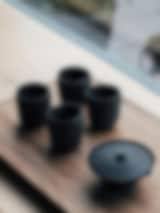
    In collaboration with ceramicist Yuichi Romita, Norrgavel has created a limited collection of objects for tea. A hand-thrown tea cup made from wild clay from Jutland and a shiboridashi, a traditional Japanese tea brewer with a low, wide shape and a matching lid. Together with oak trays made by Norrgavel, they form a small collection centred around materials, craftsmanship and use.

    We visited Yuichi in Malmö to talk about his journey from his apprenticeship in Japan to developing his own practice, the role of fire in ceramics and how objects find their full meaning only when they are used.


    norregavel_yuichi_010

    Between hand and fire: A visit to ceramicist Yuichi Romita

    Yuichi Romita still has one of the first tools he made during his apprenticeship in Japan. Carved from a piece of cherry wood, it is called a gyubera, or cow's tongue, after its distinctive shape.

    “Everyone had to start by making their own tools. I was given a piece of cherry wood and began carving,” he recalls.

    The tool is used at the potter's wheel to shape the inside of a vessel. It determines the angle and softness of the curves and is one of the defining features of ceramics from Karatsu, where Yuichi spent four years as an apprentice. Today, he lives and works in Malmö, but the hand-carved tool is still part of his practice.

    Yuichi trained in Nanban Yakishime, a Japanese tradition of unglazed, wood-fired ceramics. During his apprenticeship, he learnt to understand clay through his hands, to master techniques and to repeat the same movements until they became part of his body. But learning a craft and finding one's own way of working are not necessarily the same thing.

    It was only after moving to Denmark, and later Malmö, that Yuichi felt he had the opportunity to develop a more personal expression.

    “I found a reason to express myself, rather than simply producing for someone else. Here, there were opportunities, spaces and people. It was very liberating.”

    Today, he is part of Studio Idun, a shared workshop in Malmö where he has found a strong sense of community. Working independently leaves room for experimentation, but it also involves production, repetition and physical work. “Production can be demanding, both mentally and physically. What often makes it worthwhile for me is the wood firing.”

    Firing ceramics in a wood-fired kiln is a process that continues for several days. The fire must be fed day and night, while the temperature, airflow and movement of the ash all influence what happens to the objects inside. Some things can be guided through experience and knowledge. Others must be left to the fire.


    ”You lose some of the control. Feeding the fire through days and nights is an almost cleansing experience, but also a humbling one. There is only so much you can influence. Inevitably, there will be failures, but they also teach you something essential.”


    norregavel_yuichi_002


    For his collaboration with Norrgavel, Yuichi has worked with a cup made from wild clay from Jutland, sourced from a brickworks that has since closed. It is the last of this particular clay that he has left. Dark and coarse in texture, it is also elastic and strong. Yuichi compares it to the clay found in Echizen, Japan.

    He has thrown cups from this clay and fired them in a wood-fired kiln. The fire and ash create variations in the surfaces that cannot be entirely predicted. Each cup is the result of both the decisions Yuichi makes at the potter's wheel and what happens during firing.

    Alongside the cup, he has also created a shiboridashi a low Japanese tea brewer with a lid. The two objects form part of a limited collection for tea, complemented by an oak tray made by Norrgavel to accompany them.


    Norrgavel furniture
    Norrgavel furniture

    Yet Yuichi's own relationship with tea has not always been straightforward. Despite his years in Japan, it was only in Denmark that he truly discovered the possibilities of tea culture.

    “In Karatsu, I didn't really have a particular tea ritual. Sometimes we drank matcha at my master's home, but the tea ceremony felt too strict for me. There are so many rules. It's beautiful, but it wasn't something I could imagine enjoying every day.”

    In Copenhagen, he met Simon and Yukiko at io tehus, who were among the first to contact him about his ceramics. They introduced him to a different approach to tea and to the way objects can be used.

    “They opened up a whole new world for me. I learnt how to use the objects, how they work and what feels natural. They showed me a more relaxed and personal way of drinking tea.”


    norregavel_yuichi_025


    At Yuichi's home, we see what he means. He uses the shiboridashi and the cup he made for Norrgavel to brew tea, alongside objects from his own collection. Among them are a tray finished with urushi lacquer by a local craftsperson in Majima and a small frog figurine that he jokingly calls his tea companion.

    “He's my spirit animal,” Yuichi says of the frog. “Calm and observant.”

    There is something liberating about this small collection. The objects come from different places and periods and were acquired at different times. They do not need to belong to a particular set. What matters is how they work together and what they bring to the moment.

    For Yuichi, it is equally natural that ceramics should be used. Even objects that have taken many hours to make, that have developed unexpected surfaces in the kiln or that are particularly cherished. They are not made to sit untouched on a shelf. Beauty belongs in everyday life, in the hands holding the cup and in the small actions repeated day after day.


    “I'm drawn to things that require time and care. Both tea and ceramics have something of that. There is a sense of concentration, of being truly present in what you're doing.”


    FIVE STEPS TO MAKING TEA
    Norrgavel furniture
    Norrgavel furniture

    From his apprenticeship in Karatsu, Yuichi also carries with him the idea that a ceramic object is only seventy per cent complete when it leaves the kiln. The remaining thirty per cent belongs to the person who uses it.

    This is partly about how the material continues to develop. Over time, an unglazed cup takes on traces of hands, water and tea. But it is also about something as simple as an object finding its place in someone's life. It becomes familiar to hold, to pour from and to return to its place.

    For Yuichi, there is no contradiction between the knowledge and discipline that craftsmanship requires and the freedom to use objects in one's own way. Perhaps it is precisely this combination that interests him: learning something thoroughly, then discovering what you want to do with it yourself.