• Order as a form of calm

    With room to breathe


    What does it mean to keep order? Not striving for perfection or control, but something softer: a gentle structure to rest in. A rhythm that carries the day, the home, and the mind. Ever since Norrgavel was founded in 1993, the simple and honest design language of the Shaker tradition has been an important inspiration for Nirvan Richter — a reminder that order can inspire a profound sense of calm.

    For the Shakers, order was not an end in itself, but a form of spirituality — a way of living close to what is necessary, and letting the superfluous fall away. Simplicity, utility and honesty were foundational principles. Every object had a purpose, a place and a context. One of their guiding expressions was:

    “A place for everything, and everything in its place.”

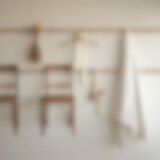
    peg rails in oak
    peg rails in oak with hanging objects

    The peg rail as principle — not just furniture


    One of their most characteristic solutions was the long line of wooden pegs running along the walls in almost every room. Peg rails were not decoration, but a living tool. Here one could hang what was in daily use: clothing, tools, brushes — even chairs.

    When objects were lifted off the floor, the room opened up, and the space could be swept through in a single motion. Order wasn’t something you “did” — it was a habit, a flow, a motion. Surfaces could remain clear. The gaze could rest. The room allowed space to breathe.

    This was not minimalism as style, but simplicity as a way of living — letting the essential be visible, and allowing everything else a quiet place close at hand.


    Storage and spatial calm


    “If the last century was bent on accumulating, we are (now) equally insistent on getting rid of the clutter. (…) Our appreciation of space is one reason for our appreciation of the airiness and roominess of the Shaker style.”

    — Curator and author June Sprigg in By Shaker Hands

    Shaker homes were built with storage that followed the lines of the architecture and walls. Objects could rest behind doors — close at hand, but without dominating the room. The result was an unusual stillness, a palpable calm.

    Here, order was not about hiding or removing, but about letting things have their lovingly designated place. Cabinets, shelves and chests carried not only things, but spatial presence — proportions that let the eye rest, materials that age with dignity. Storage became part of the architecture itself, and the room felt lighter to inhabit.

    peg rail in oak

    Utility before ornament


    The Shakers pared things back — not to create emptiness, but clarity. If an object had a purpose, it stayed. If it was not used, it left the room. Objects became beautiful through their use. Form followed function. The material was allowed to speak for itself.

    What has a place and a purpose in the home? That is for each of us to decide — but it is a valuable question to carry with us.

    At Norrgavel, these questions and thoughts have occupied us for a long time. Not as a style, but as a mindset. To shape objects that feel necessary rather than numerous. To let natural materials speak, and to create furniture and everyday objects carried by function, resonant proportions, and honesty in construction.

    Like the Shaker tradition, we believe that beauty arises when something is made with care and for a reason. That an object used every day should be easy to like — and easy to live with.


    Order as presence


    For the Shakers, the home was the closest thing to heaven on earth. When we draw from their principles in today’s homes, it is not about recreating their world — but about paying attention to our own. The ritual of bringing something out. Returning what we’ve used. Folding slowly. Letting the silence inhabit the space. Small actions that create clarity — in the room, in the body, in the mind.

    Order as a form of kindness. Order as a form of peace. When everything has its place, the room has room to breathe — and we with it.